
Hot-Fill Hold Processing in Foods: A Practical, Engineering Guide

Updated: Jan 1
Hot-fill–hold (HFH) is a widely used thermal processing and packaging strategy for acid and acidified foods (fruit preparations, sauces, salsas, dressings, and many beverages) because it can deliver shelf-stability with relatively straightforward unit operations—if the critical factors are defined, measured, and controlled (UGA, 2025; FDA, 2025).
1) What “hot-fill–hold” means in practice
HFH is a practical thermal processing method used to achieve commercial sterility in acid and acidified foods (pH ≤ 4.6), i.e., a validated process that delivers commercial shelf-stability by preventing pathogen growth/toxin formation and controlling spoilage under normal distribution and storage. Acidity acts as a primary hurdle, preventing the growth and toxin formation of Clostridium botulinum (KSRE, 2024; UW–Madison, 2024). The objective shifts to maintaining the scheduled thermal process and preventing post-lethality contamination. Under 21 CFR Part 114, HFH-relevant products are generally:
Acid foods: natural pH ≤ 4.6
Acidified foods: low-acid foods with added acid/acid foods; aw > 0.85; finished equilibrium pH ≤ 4.6 (FDA, 2025).
For acidified foods, compliance hinges on a scheduled process with controlled equilibrium pH and other critical factors (FDA, 2025). Because HFH filling is not aseptic, contamination prevention relies on GMP/CGMP controls (historically 21 CFR 110; now under 21 CFR 117 CGMP framework) and, in the EU, hygiene law requires HACCP-based procedures (Reg. (EC) No 852/2004) (FDA, 2025; EU, 2004).
In industrial reality (Fig. 1), the process separates the objectives into three key stages to ensure both the product and the container interior surfaces are treated effectively:
Product Lethality: The food product is heated in upstream equipment (heater + hold section) to a validated temperature for a specific time to achieve the required microbiological kill step.
Filling Temperature Control: The product is maintained at a specified minimum fill temperature while in the filler bowl.
Container Treatment: The hot product fills the container, treating the interior surfaces, headspace, and closure interface through direct contact. This often involves inverting or laying down the container for a specified duration, with the end-of-hold product temperature serving as a critical control point.
This closure-surface intent is explicit in FDA’s Form FDA 2541e, which asks how the container, headspace, and closure interior are treated (e.g., inversion/laydown, heating tunnel) and requests the end-of-hold temperature (FDA, 2024).
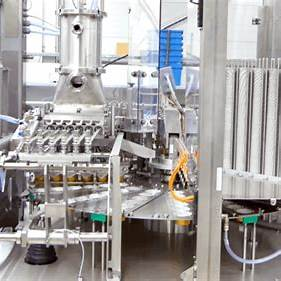
Figure 1. Example of Hot-fill filling and capping station on a sanitary beverage/food packaging line (filler bowl, multi-head filler/capper turret, and container handling conveyor), where closure-interface hygiene and end-of-hold temperature control are critical to HFH performance.
2) Typical operating range and quality constraints
Public guidance commonly describes HFH with hot-fill temperatures around 185–212 °F (85–100 °C) for a validated time—ranging from seconds to minutes depending on product pH, viscosity/heat transfer, and packaging format (Table 1); but the practical upper bound is often set by quality and packaging constraints (texture/rheology changes, ingredient stability, package deformation, vacuum/closure performance) (UGA, 2025; KSRE, 2024; UW–Madison, 2024). Rigid containers often achieve this via inversion/laydown to wet the closure/headspace surfaces with hot product, while flexible packages (e.g., pouches/spouts) more commonly rely on post-pasteurization after sealing to deliver a measurable surface treatment without depending on inversion mechanics (UGA, 2025).
Table 1. Suggested F-values for high-acid and acidified products (Tref = 200 °F; z = 16 °F) (Tucker & Featherstone, 2011, p. 80).
pH range | F-value (min) |
< 3.9 | 0.1 |
3.9–4.1 | 1.0 |
4.1–4.2 | 2.5 |
4.2–4.3 | 5.0 |
4.3–4.4 | 10.0 |
4.4–4.5 | 20.0 |
Note that these targets are intended to inactivate yeasts, molds, and vegetative spoilage bacteria (and support >5-log reductions of vegetative pathogens), but they are not designed to eliminate heat-resistant molds or acidophilic sporeformers (e.g., Alicyclobacillus spp., Bacillus coagulans). Where these organisms matter, risk reduction shifts toward ingredient quality and strict hygienic control consistent with CGMP expectations.
Applications
The HFH process is widely applied across the food industry for products where acidity inhibits microbial growth:
Beverages: Fruit juices, sports drinks, ready-to-drink teas, and lemonades.
Condiments: Ketchup, BBQ sauces, steak sauces, and salad dressings.
Salsas and Dips: Tomato-based salsas (mild to hot).
Fruit Preparations: Jams, jellies, pie fillings, and fruit purees.
3) Packaging formats and why solutions differ by container
HFH performance depends on controlled exposure at the closure/headspace interface, not the bulk product alone. The key engineering question is how the line achieves validated treatment of the container finish/headspace/closure interface without unacceptable quality loss, container damage, or excessive cost (Table 2) (FDA, 2024).
3.1 Small rigid plastics (PET cups/tubs; small bottles)
Inversion/laydown is mechanically straightforward and easy to monitor. A frequent failure mechanism is seal-area contamination from splashing/stringing; documented mitigation includes bottom-up filling to reduce splashing and improve seal consistency (Packaging, 2025).
3.2 Glass jars
For glass jars, inversion may be operationally undesirable at high speed due to breakage risk and downtime. Processing plants, therefore, use alternative approaches that target the same closure-surface intent:
Post-fill heating tunnel / post-pasteurizer to control the time-temperature profile after closure (footprint/energy tradeoff).
Steam-flush (steam-flow/steam-vacuum) at the capping zone to treat the headspace/closure region; condensate control and product tolerance must be evaluated.
UV-C treatment of caps/finish areas where delivered dose can be validated under the actual geometry and line-speed constraints.
3.3 Large rigid PET bottles (e.g., gallon formats) with small neck/closure
Large-format bottles amplify closure-surface challenges: the closure interface area is small relative to package thermal mass, and extended contact times may be required. In practice, many systems converge to the same three options listed for glass (post-fill tunnel profile control, steam treatment at capping, or UV-C with validation), selected based on product sensitivity and plant constraints.
3.4 Pouches and spouted pouches
For flexible packages, the dominant technical risk is the heat-seal and/or fitment interface. Seal integrity depends on sealing temperature, pressure, dwell time, materials, and contamination at the seal interface. Many lines therefore use a post-fill thermal treatment (post-pasteurization) after sealing to deliver a measurable exposure without relying on inversion mechanics (KSRE, 2024).
Table 2. Container types and HFH considerations.

4) Common failure: mold/yeast spoilage
Most HFH spoilage investigations and failures (Table 3) collapse into two root causes:
4.1 Inadequate processes for heat-resistant yeasts and molds
One of the most common HFH failures is yeast and mold spoilage. This often occurs when the thermal program is designed primarily around a vegetative-pathogen performance target (e.g., 5-log reduction for Listeria, Salmonella, and E. coli) but does not provide sufficient lethality for more thermally tolerant spoilage organisms, especially heat-resistant molds and thermotolerant yeasts. In these cases, a process may meet pathogen-reduction expectations yet still fail to achieve commercial stability. Therefore, HFH time–temperature targets must be established for the specific product and packaging system, including the intended container/headspace/closure treatment, and verified under worst-case operating conditions (minimum end-of-hold temperature, maximum line speed, and start-up/changeover conditions) (KSRE, 2024; UW–Madison, 2024).
4.2 Cross-contamination (GMP execution)
Even when the scheduled time–temperature treatment is adequate, HFH can fail if post-cross-contamination occurs during product transfer, filling, or closure application. In HFH systems, the product is exposed to the filler environment, and the critical risk becomes re-contamination of yeasts/molds onto the product stream or into the closure/finish interface (splashing/stringing, wet contact surfaces, contaminated caps, or poor drainage at the capper). Because these organisms can grow at low pH, even small contamination events can drive spoilage over shelf life. A defensible HFH program therefore, requires hygienic equipment design (cleanable geometry, no harborage points, controlled condensate), verified CIP effectiveness (validated cycles and routine verification), strict closure handling and storage controls, and operating practices aligned with GMP expectations (sanitation, employee practices, environmental control, and corrective-action documentation) (FDA, 2025).
Table 3. Typical HFH failure points (problem → issue → consequence)

5) Practical engineering checklist for a defensible HFH design
A technically defensible HFH program documents and controls:
Product category and regulatory basis: acid vs. acidified classification; equilibrium pH measurement plan (FDA, 2025).
Scheduled process and critical factors: setpoints/tolerances for equilibrium pH, fill temperature, hold time, and minimum end-of-hold product temperature at a defined measurement location (FDA, 2024; FDA, 2025).
Closure/headspace treatment method: inversion/laydown angle/time or alternative validated method; how it is monitored and recorded (FDA, 2024).
Instrumentation and records: calibrated sensors, defined logging frequency, lot traceability, and record retention (FDA, 2025).
Container-closure integrity controls: seal checks (torque/vacuum where applicable), leak testing, post-cool inspection (KSRE, 2024; UW-Madison, 2024).
Deviations: predefined corrective actions and product disposition rules aligned to critical-factor requirements (FDA, 2025).
6) Validation mindset: what you must be able to prove
HFH validation is documented evidence that the line consistently achieves minimum conditions under worst-case operating scenarios:
Equilibrium pH control (acidified foods): sampling plan, meter calibration, acceptance limits, and rework/hold rules (FDA, 2025).
Time-temperature at the control point: proof that minimum end-of-hold temperature and hold time are achieved at line speed and under start-up/changeover conditions (FDA, 2024; UW-Madison, 2024).
Conduct a Thermal Process Authority Study: Engage a qualified processing authority to determine the necessary time/temperature combination to achieve the target lethality (e.g., a 5-log reduction of a relevant spoilage organism like Aspergillus niger spores).
Closure/headspace treatment execution: defined settings (inversion, tunnel, steam, or UV where used) and records showing consistent execution (FDA, 2024).
Container-closure integrity verification: objective checks demonstrating integrity after cooling and routine handling (KSRE, 2024).
Establish Control Limits and Monitoring: Set clear, measurable control points for line operators (e.g., "Filler temperature must be at 190°F," "Inversion time must be at 60 seconds"). Implement continuous monitoring systems (e.g., chart recorders, data acquisition systems) (KSRE, 2024).
Maintain Documentation: Keep rigorous records of all monitoring activities, deviations, and corrective actions. This documentation is essential for regulatory compliance with agencies like the FDA and adherence to good manufacturing practices (GMPs).
Published examples can support early screening, but the validated HFH schedule must be specific to the product, container/closure system, and the actual production line.
Where Advanced Food-Tech Solutions can help
We typically support HFH teams with engineering-first work products:
HFH line audits (filler → capper → hold → cooler): identify failure modes (temperature drop, seal contamination, insufficient closure exposure).
Critical-factor mapping & control plan: define what is truly critical (equilibrium pH, fill/hold/end-of-hold temperature, closure/headspace treatment), where to measure it, and how to document it.
Instrumentation & data logging plans: sensor placement, calibration routines, logging frequency, worst-case capture.
Packaging/closure fit-for-purpose assessment: hot-fill compatibility, deformation risk, and integrity verification plan.
Documentation packages aligned to filings/audits: scheduled-process narrative, monitoring records, deviation handling consistent with regulatory expectations.
AdvThermaLogic implementation support: configure the Acid vs. Acidified Classification and HFH Process Builder modules to standardize equilibrium pH control, closure-treatment (inversion), end-of-hold temperature logging, and audit-ready reporting.
References
European Union (EU). (2004). Regulation (EC) No 852/2004 of the European Parliament and of the Council of 29 April 2004 on the hygiene of foodstuffs (Article 5: HACCP-based procedures).
Kansas State University Research and Extension (KSRE). (2024). Hot-Fill-Hold Process for Acid and Acidified Foods (MF3671). KSRE Bookstore. (Getty, K., & Gaikwad, R.).
Packaging Technology Today. (2025). Gwin, M. Overcoming Hot-fill Challenges. Packaging Technology Today.
Tucker, G., & Featherstone, S. (2011). Essentials of Thermal Processing. Wiley-Blackwell (John Wiley & Sons).
U.S. Food and Drug Administration (FDA). (2024). Food Process Filing for Acidified Method (Form FDA 2541e).
U.S. Food and Drug Administration (FDA). (2025). 21 CFR Part 114 — Acidified Foods (including §114.3 Definitions). eCFR.
U.S. Food and Drug Administration (FDA). (2025). 21 CFR Part 117 — Current Good Manufacturing Practice, Hazard Analysis, and Risk-Based Preventive Controls for Human Food. eCFR.
University of Georgia Extension (UGA Extension). (2025). Producing Shelf-Stable Acidified Foods Using Hot-Fill-Hold (Circular C 1328-02).
University of Georgia Extension (UGA Extension). (2025). Preserving Acidified Foods Using the Hot-Fill-Hold Process (Circular C 1328-03).
University of Wisconsin–Madison (UW Food Safety). (2024). Developing a Hot-Fill-Hold Process for Acid or Acidified Foods. UW–Madison Food Safety Program.



Comments